



President Trump and Vice President J.D. Vance staunchly defended the recently signed U.S.-Iran memorandum of understanding Thursday, insisting the deal will be better for regional security even as critics say it rewards Tehran.
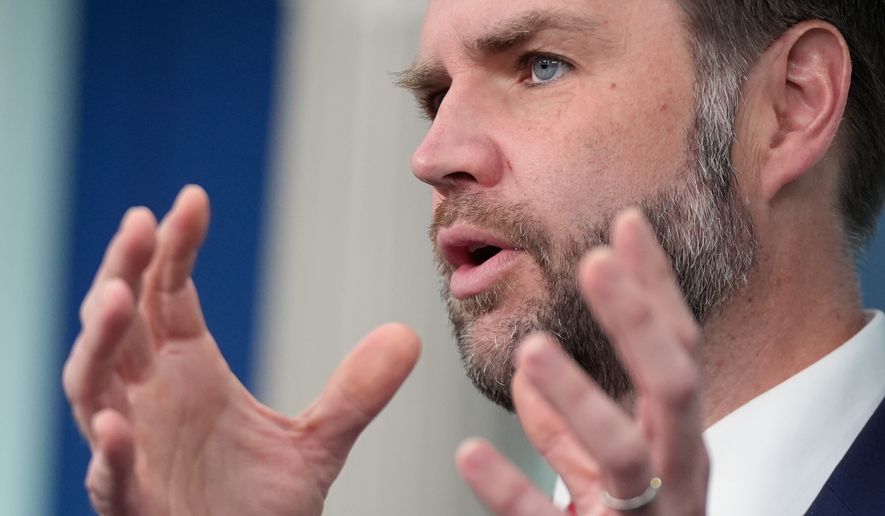
Speaking at the White House press briefing in place of press secretary Karoline Leavitt, who is on maternity leave, Mr. Vance confirmed that the agreement allows for the toll-free reopening of the Strait of Hormuz and the end of the U.S. naval blockade of Iran’s ports.
“We don’t ever want this to happen again,” Mr. Vance said. “That’s not about tolling; that’s about ensuring that the straits are never used as a choke point for the global economy ever again.”
He said at least 12.5 million barrels of oil had passed through the waterway since the agreement was signed this week and that Iran had not fired on any ships traveling through the strait in two days.
Brent crude oil prices fell to about $78 per barrel Thursday, the lowest since the start of the war, and West Texas Intermediate crude fell to about $75 per barrel.
The U.S. instituted the blockade on Iranian ports in April in retaliation for Iran’s blocking of the Strait of Hormuz, which it had maintained since early March.
U.S. stocks continued to climb Thursday. The Nasdaq composite rose 1.9%, and the S&P 500 rose 1%. The Dow Jones Industrial Average inched up 0.14%.
The negotiations hit a snag though.
Mr. Vance had been scheduled to leave for Switzerland on Thursday evening to lead a new round of talks to add details to the agreement on Iran’s nuclear program.
But the White House said that this would not happen as planned, saying plans for the technical talks have not been finalized. It added that U.S. officials are ready to depart at the first available opportunity.
Earlier on Thirsday, U.S. Central Command said that “all U.S. military blockade enforcement efforts have ceased” in the Gulf of Oman and the Persian Gulf in accordance with Mr. Trump’s direction. Still, CENTCOM said, U.S. naval ships will remain in the area to ensure that all aspects of the memorandum of understanding are “adhered to, obeyed and in full force and effect.”
The U.S. and Iran signed the agreement electronically Wednesday after reaching an agreement on the terms over the weekend. The memorandum of understanding allows for a 60-day ceasefire, during which the U.S. and Iran will begin negotiations over Tehran’s nuclear program and sanctions relief, among other issues.
SEE ALSO: Iran says its missiles not part of peace talks
Iran’s supreme leader, Mojtaba Khamenei, said Thursday that he approved of the memorandum of understanding despite serious reservations. In a statement attributed to him carried by state-affiliated media, he said Iran would enter negotiations with strength and would not agree to any “excessive demands” made by Washington.
The agreement does not include destroying or limiting Iran’s ballistic missile capabilities, which Mr. Trump said in March was a goal of Operation Epic Fury.
The Iranian government said limits on its large force of ballistic missiles will not be part of the negotiations.
“Our missiles do not like at all to be talked about by anyone,” Iranian Foreign Ministry spokesman Esmaeil Baqaei told Iranian state television.
“Iranian missiles are only for firing, not for negotiations. Iran’s defense capability will not be discussed in any way, in any process or with any party,” he said, according to Agence France-Presse.
Mr. Trump signaled openness to that position. On Wednesday, he said, “If other countries have them, it’s a little bit unfair for Iran not to have some.”
The clearing of the strait and the removal of the naval blockade will let Iran continue exporting its oil.
The Treasury Department will issue waivers for the export of Iranian crude oil and petroleum products that were previously subject to sanctions.
Critics of the deal say the waivers will provide Iran with an economic lifeboat just as the U.S. sanctions and blockade were taking effect.
Mr. Vance argued that Iran’s economy is still in “free fall” and that the agreement will ensure stability returns to the global economy.
When asked by The Washington Times about reports that Iran is beginning to funnel oil profits to Hezbollah fighters in Lebanon, Mr. Vance said Tehran’s continued support for its terrorist proxies is precisely the reason the agreement was needed in the first place.
“It’s interesting that people will say the MOU is bad because the MOU produces consequences that were actually happening well before the MOU was signed,” he said. “That’s not a reflection of the MOU; that’s a reflection of why we need the MOU to ensure we have the regional peace and stability we need.”
Reports this week indicated that Iran is looking to use renewed oil revenue to bolster Hezbollah’s financial and political situation inside Lebanon after the signing of the U.S.-Iran memorandum of understanding.
Still, Mr. Vance and other U.S. officials have insisted that Iran will not receive any substantial sanctions relief unless it changes its behavior.
“It’s going to be a holistic approach where we look at their behavior: Are they funding terrorism, are they leading to attacks on other people, are they trying to get centrifuges to redevelop their nuclear weapons program?” Mr. Vance said.
The deal states that both parties will negotiate possible primary and secondary sanctions relief during a 60-day negotiating period, which Mr. Vance said began Thursday.
The full text of the agreement was released Wednesday, and the White House submitted the document to Congress on Thursday.
Lawmakers wasted no time criticizing Mr. Trump’s deal, with Republicans and Democrats expressing disappointment and alarm.
Many lawmakers said the U.S. was giving up its most important piece of leverage by agreeing to end its naval blockade and letting Iran continue selling oil.
“Starting next week, Iran will be able to sell oil without sanctions, and the strait is permanently under their control,” said Sen. Chris Murphy, Connecticut Democrat. “It’s a national embarrassment, but I guess it’s the price we have to pay to end this incompetent war that was getting more disastrous every day.”
There was also concern on Capitol Hill about the provision in the memorandum of understanding stating that Iran will receive $300 billion for reconstruction and economic development.
“It’s not going to be used for constructive, useful purposes,” said Sen. John Cornyn, Texas Republican.
U.S. officials, including Mr. Trump, have said that American taxpayers will not foot the bill for the construction fund and that much of the money will come from regional partners in the Middle East.
“There is no 300 Billion Dollar payment to Iran by the U.S. That’s Fake News! All there is for the U.S. is Success, Lower Oil Prices, and Victory. Check out the Stock Market. Dumocrat propaganda at play!!!” Mr. Trump wrote Thursday on Truth Social.
Criticism of the deal is also coming from Israel, where officials in Prime Minister Benjamin Netanyahu’s administration have denounced the agreement and Mr. Trump’s decision to end the war.
National Security Minister Itamar Ben-Gvir said the deal “does not bind” Israel and that his country should not support any deal “that does not ensure our security.”
Finance Minister Bezalel Smotrich said the deal is bad for “the entire free world” and encouraged Israel to defy the agreement.
Members of the opposition, including former Prime Minister Yair Lapid, said the deal’s terms mean Israel lost the war with Iran and are a clear reason for the Israeli public to oust Mr. Netanyahu’s government in the upcoming elections.
Mr. Vance hit back at Israeli critics of the deal by saying that anyone who thinks that Mr. Trump is their biggest problem “needs to wake up and smell the reality of the situation that the country is in.”
“My message to them is Donald J. Trump is the only head of state in the entire world who is sympathetic to the nation of Israel at this moment in time,” he said.
The comments follow several days of uncharacteristically critical remarks by Mr. Trump about Mr. Netanyahu.
Speaking to the press at the Group of Seven summit in France this week, Mr. Trump said the Israeli military needs to show more restraint in Lebanon and that Israel should accept the terms of the memorandum of understanding.
Still, Mr. Trump said Thursday that he had a “good relationship” with Mr. Netanyahu and is ready to meet with him soon.
Much of Israel’s opposition to the deal centers on the agreement’s provision for a ceasefire on all fronts, including in Lebanon, where Israeli troops are still occupying a large swath of southern Lebanon.
The Israeli military released a map Thursday of the “security zone” it created in southern Lebanon and said its forces would remain there to deter further attacks on Israelis. The zone stretches from Israel’s northern border about 6 miles into Lebanese territory.
Israeli strikes have eased since the announcement of the U.S.-Iran agreement, but have not halted altogether. Israeli drone strikes killed at least two people in the southern Lebanese town of Kfar Tebnit on Thursday, according to the state-run National News Agency.
Mr. Trump urged all parties in the Middle East to adhere to the ceasefire while negotiations play out over the next 60 days.
“We encourage everyone in the Middle East Region to maintain their commitment to allowing our negotiations to beautifully unfold,” Mr. Trump added in a social media post.
• Kerry Picket and Bill Gertz contributed to this report.
Contact the author


Please read our comment policy before commenting.