



A version of this story appeared in the daily Threat Status newsletter from The Washington Times. Click here to receive Threat Status delivered directly to your inbox each weekday.
LONDON — When a team of Chinese medical experts landed this month at the airport in Kinshasa, healthcare officials from the Congo were there to greet them with open arms.
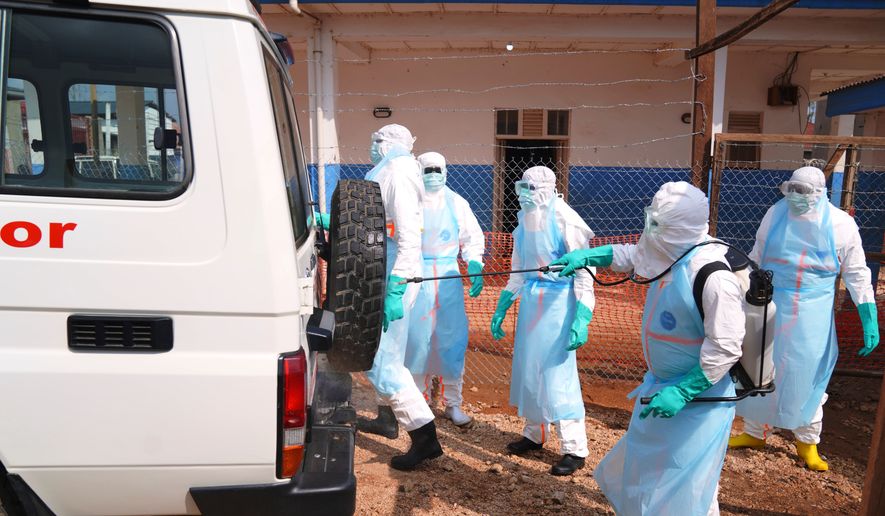
The central African nation of 116 million people is struggling to contain the fastest-growing Ebola epidemic its ever seen, with more than 4,000 cases and over 2,000 deaths — an outbreak that is on track to become the deadliest in history, the head of the World Health Organization said Wednesday.
And with the U.S. pulling back on aid to Africa, China has seized the opportunity to step up its efforts to win hearts and minds on the continent. The medical team that arrived Aug. 2 was the third Beijing has sent.
The fast-moving outbreak is mostly concentrated in eastern Congo’s remote Ituri Province, which accounts for nearly 90% of cases, but there have been others confirmed in five provinces, including in one of the country’s largest cities, Kisangani.
Ebola is rare, but highly contagious and can be contracted via bodily fluids such as vomit, blood or semen. The disease it causes is severe and often fatal.
At least 44 infected healthcare workers have died. Many other healthcare workers have walked off their jobs, protesting the lack of payment. At least 12 attacks have been recorded against health facilities and teams since the outbreak was declared in mid-May.
For the country’s overwhelmed medical workers, the Chinese teams look like the cavalry coming over the hill.
For China, the Ebola crisis is an opportunity to challenge the U.S. in Central Africa.
Beijing is deploying medical aid and diplomats in a show of strength as President Trump pursues peace and access to Congo’s strategic minerals.
On July 17, Beijing announced an additional $2.5 million for the African Union’s Ebola response, led by Africa CDC.
China said nearly 1,000 Chinese medical personnel are helping African countries fight the outbreak.
Their deployment comes as cuts to U.S. foreign assistance have left gaps across a region where the Trump administration is also attempting to end one of Africa’s most persistent conflicts.
“U.S. aid was one of the biggest sources of support for humanitarian efforts in the [Democratic Republic of Congo], and [the outbreak] has shown how difficult Ebola can be to contain without international support,” said Passy Mubalama, a Congolese analyst and human rights advocate. “As a result, China is stepping in to fill the gap.”
“At its current pace, it’s on track to eclipse the West African Ebola outbreak of 2014 to 2016,” the WHO’s Tedros Adhanom Ghebreyesus told reporters Wednesday.
“The outbreak had a big head start, still way ahead of us, and we’re playing catch-up,” he said.
Dr. Abdirahman Mahamud, the WHO’s director for health emergency alert and response operations, said the agency expects the peak of the outbreak to be reached in six months.
“But … that’s the moderate scenario,” Dr. Mahamud said. “There is a one-case scenario where this outbreak may last nine months to 12 months.”
Washington’s most visible Ebola-related effort has been the opening of a quarantine facility in central Kenya that is housing seven American aid workers who recently returned from Congo. The facility proved controversial in Kenya, where its construction faced public protests and a court order suspending the project.
The Trump administration also has created an Ebola task force involving the Centers for Disease Control and Prevention, the State Department and the Department of Defense. The administration has imposed travel restrictions on people who recently visited affected countries.
Mr. Trump said his administration “cannot and will not allow” any cases of Ebola to enter the U.S. The crisis has also complicated U.S.-backed peacemaking efforts in eastern Congo.
The outbreak produced Europe’s first imported case, although the humanitarian doctor, who was diagnosed after returning to France, has recovered.
In neighboring Uganda, authorities discharged the country’s last Ebola patient on July 16 and began the 42-day countdown toward declaring the outbreak there over.
China has called for BRICS — a bloc of major emerging economies seeking greater influence in global affairs and less dependence on the U.S. dollar — to play a leading role in the response. Its members are Brazil, China, Egypt, Ethiopia, Indonesia, India, Iran, Russia, Saudi Arabia, South Africa and the United Arab Emirates.
“During COVID, China was much more aggressive in delivering assistance to countries where it had important strategic interests,” said Ken Moriyasu, a senior fellow at the Hudson Institute, in an interview with The Washington Times. “Its more restrained response to Ebola suggests that China’s overseas engagement has become more selective and more closely tied to cost-benefit calculations.”
Chinese foreign policy has often tied humanitarian assistance to longer-term goals, including protecting Beijing’s access to critical minerals and its dominance of their supply chains.
A 2022 meeting of BRICS countries called for closer cooperation in preventing and responding to infectious disease outbreaks.
The current Ebola crisis presents China with an opportunity similar to the one it seized during the COVID-19 pandemic.
“In Guinea, China delivered COVID-19 vaccines as it pursued access to Simandou, the world’s largest untapped reserve of high-grade iron ore,” Mr. Moriyasu said. “The project offered Beijing an opportunity to reduce its dependence on Australian ore. Chinese companies later helped finance the railway and port needed to bring Simandou into production.”
China already dominates much of the Democratic Republic of the Congo’s mining industry, but Washington has sought to challenge Beijing’s primacy. The U.S. hopes renewed engagement will create opportunities for American companies to gain access to Congo’s copper, cobalt and other strategic minerals.
Mr. Trump’s second administration has made the DRC a major focus of its diplomatic engagement.
Key efforts include brokering agreements between Congo and Rwanda and supporting separate negotiations with the Rwanda-backed M23 rebel movement, which controls large swaths of eastern Congo.
The Congo has been riven with armed groups since the rebellion that toppled Mobutu Sese Seko in 1997. The fighting and its aftermath are blamed for an estimated 5.7 million deaths, with most of those attributed to disease and starvation.
• This article is based in part on wire service reports.

Please read our comment policy before commenting.