


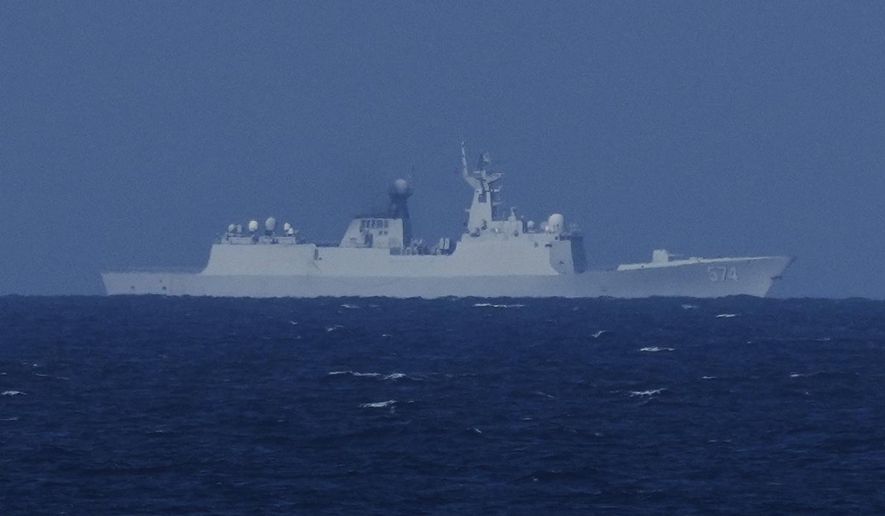

The State Department on Thursday called a joint Chinese naval maneuver with an Indonesian warship in waters east of Taiwan a destabilizing act, while Taipei denounced the maneuver as “dangerous.”
“The United States urges Beijing to cease its continuous military pressure against Taiwan and instead engage in meaningful dialogue with Taiwan,” a State Department spokesman said.
“We call on other countries to encourage the peaceful resolution of cross-Strait issues instead of amplifying Beijing’s destabilizing narratives,” the spokesman told The Washington Times in response to the joint Chinese-Indonesian naval drill Wednesday.
The Chinese Defense Ministry said the exercise was conducted about 70 to 80 nautical miles east of Taiwan. State media said the “navigation exercise” involved two frigates.
Indonesia’s navy said the maneuver was a simple passing exercise involving two warships that coordinated a nearby transit.
In Taipei, the government’s Mainland Affairs Council called the exercise a military provocation and said in a statement that China should “immediately stop this dangerous behavior that undermines the status quo.”
The council said the exercise followed other troubling Chinese actions, including Beijing’s claims of routine “law enforcement patrols” in waters east of Taiwan.
The Chinese military is now doing military drills with “relevant countries,” the statement said.
“This is, in reality, political manipulation, ‘exercises in name, expansion in fact’, aimed at creating a false impression before the international community that the Chinese communists have jurisdiction over waters east of Taiwan,” the statement said.
The exercise was tracked through commercial imagery as taking place inside Taiwan’s exclusive economic zone, the online news outlet Domino Theory reported.
The unusual joint drill took place as Elbridge Colby, U.S. undersecretary of defense for policy, met on Tuesday in Jakarta with Indonesian Defense Minister Sjafrie Sjamsoeddin and with Indonesian President Prabowo Subianto on Wednesday.
In April, Indonesia signed a defense cooperation agreement with the Pentagon as part of American efforts to bolster regional defenses against China.
The Chinese-Indonesian exercise is viewed by some analysts as a setback for the U.S. effort.
Mr. Sjafrie told Mr. Colby that expanding defense ties will not include setting up a U.S. military base in Indonesia, the defense minister’s office said in a statement.
Retired Navy Capt. Jim Fanell, a former Pacific Fleet intelligence director, said the unusual naval drill is part of Beijing ramping up a campaign to annex Taiwan.
Recent operations by coast guard and naval ships east of Taiwan in international waters are unprecedented and an attempt to gain control over them, he said.
“Essentially China has now got another nation to acknowledge the legitimacy of their claims to these waters [east of Taiwan],” Capt. Fanell said. “And it comes just a day or two after our Department of War undersecretary for policy Elbridge Colby gave a speech in Manila talking about our commitments, how we would be strong, clear but quiet policy in terms of not provoking China, not peacocking as he called, the Chinese.”
Mr. Colby’s comments were a green light for China to conduct the joint naval drill, he said.
Indonesian Navy Adm. Tunggul, director of the navy information service, said the frigate KRI I Gusti Ngurah Rai-332 took part in the drill after returning from an exercise with the Russian navy in Vladivostok.
“The Passing Exercises are not warfighting in nature, but rather a universal naval tradition conducted when passing through the waters of another country,” he said, noting the activities mark “goodwill engagements” commonly conducted by navies.
The admiral made no mention of the location or China or Taiwan.
Indonesian Foreign Ministry spokeswoman Yvonne Mewengkang said Thursday during a media briefing that the drill was government-to-government diplomacy.
“For Indonesia, such interactions are part of maritime diplomacy,” she said. “The sea is not just a space connecting nations, but a space to build cooperation and mutual trust.”
The exercise was not a combat drill and aligned with Jakarta’s free and active foreign policy, she said.
The naval maneuver also followed annual war games in Taiwan called Han Kuang. This year’s exercises included large-scale military exercises simulating a defense against an attempted Chinese invasion.
China views Taiwan as its territory, while the current government in Taipei regards the democratic state as independent.
The U.S. is bound to provide defensive weapons to prevent a Chinese military takeover under the 1979 Taiwan Relations Act.
Contact the author


Please read our comment policy before commenting.