


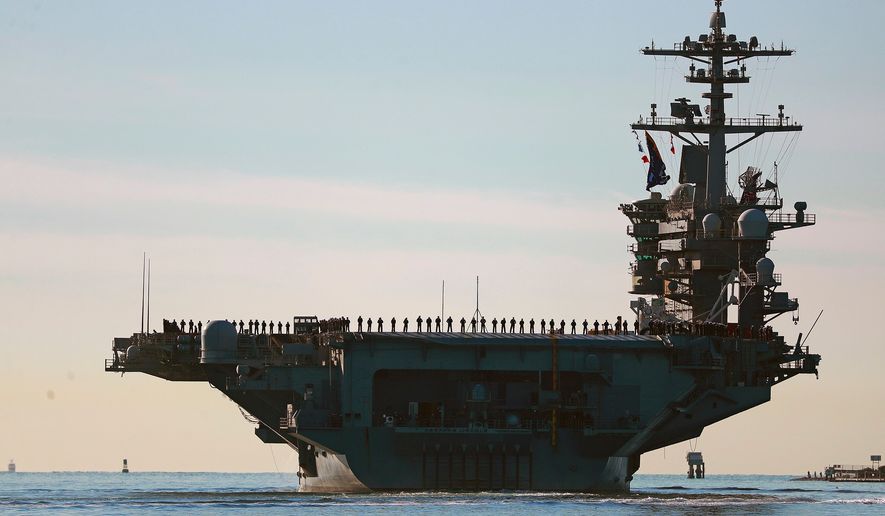

Secretary of Defense Pete Hegseth said reports of poor living conditions and food shortages aboard the USS Abraham Lincoln aircraft carrier were “completely misrepresented,” even as lawmakers demand answers about the well-being of the sailors and Marines who have been continuously at sea for more than seven months.
Speaking to reporters in Panama on Thursday, Mr. Hegseth acknowledged that some deployments last longer and are tougher than others.
“We make sure that every ship, every crew, every captain, has everything that we can provide them at every single moment,” he said. “I have more respect and gratitude for those sailors than anybody. What they do on the high seas in austere conditions with less port calls is incredible.”
Families of crew members have told reporters that morale has plummeted aboard the aircraft carrier as a result of a grueling and extended combat deployment to the Middle East. They have reported cases of severe exhaustion and mental health pressures among the 5,000 Marines and sailors aboard the ship, including multiple attempts to die by suicide by jumping overboard.
The San Diego-based nuclear-powered carrier has played a frontline role in U.S. military operations in the Middle East, serving as a primary launchpad for combat aircraft missions amid the ongoing war with Iran.
The deployment was scheduled to end in May but has been extended with no publicly announced return date, though defense officials have confirmed that the USS George Washington is being sent to replace the USS Abraham Lincoln, according to multiple reports.
Annabella Luna said she has been kept in the dark for weeks since her emotionally exhausted husband attempted to take his life by jumping overboard.
“He’s scared. He thinks he’ll get a dishonorable discharge, and just because he was burnt out, his 13-year career is over, just like that,” she told the Navy Times newspaper. “That’s not fair. That’s not right. That’s not what he should be worrying about right now.”
Sen. Richard Blumenthal, a Connecticut Democrat who serves on the Senate Armed Services Committee, sent a letter Wednesday to Mr. Hegseth and Navy Secretary Hung Cao demanding to know what is being done to improve conditions for the sailors aboard the Abraham Lincoln.
“There have been widespread reports of shortages of basic supplies, water contamination, plumbing issues, deteriorating mental health, deck safety concerns and disruptions of the mail system which have caused many care packages en route to the ship to be lost in transit for months,” Mr. Blumenthal said.
He said the reports warrant immediate attention but also raise a broader question: Can the Navy sustain the operational tempo being demanded of its carrier force?
“Particularly as [the Trump administration] repeatedly commits U.S. forces to conflicts of its own choosing and increasingly relies on aircraft carriers to sustain those operations,” Mr. Blumenthal said.
Shelby Sanders, a high school student whose mother is an Abraham Lincoln crew member, told Navy Times that she can tell her mom is struggling.
“When she can email me, she’s definitely down,” the teen said. “I think they’ve had five weeks of nonstop combat operations or something like that. That makes it really tough to communicate consistently or even know if we’ll be able to. It sucks.”
Rep. Don Bacon, a Nebraska Republican who serves on the House Armed Services Committee, agreed that long deployments are always hard on service members and their families.
“I remember our soldiers doing 18-month tours in Iraq and Afghanistan, and it was excruciatingly difficult. I am glad the USS Abraham Lincoln will soon be replaced by the USS George Washington,” Mr. Bacon, a retired Air Force brigadier general, told The Washington Times. “I thank the sailors for their service and clearly their sacrifice. Our aircraft carriers are indispensable to our national security and to countering Iran in the Strait of Hormuz.”
Mr. Blumenthal said the situation aboard the Abraham Lincoln is not an isolated case.
Recent carrier deployments have repeatedly stretched beyond their original durations, suggesting that extended deployments may be becoming a feature rather than an exception of the Navy’s current force posture.
He has previously raised concerns about the mental health of sailors facing extended deployments and harsh living and working conditions.
In 2022, five sailors aboard the USS George Washington committed suicide, including three in one week in April.
The deaths occurred while the carrier underwent a lengthy overhaul at the Newport News Shipyard in Virginia.
Sal Mercogliano, a history professor at Campbell University in North Carolina who holds a Merchant Marine deck officer license, said some of the shortage problems for the USS Abraham Lincoln and other warships in the Middle East are a result of a lack of access to bases in the Persian Gulf.
That means the food has to be procured from local sources in the Indian Ocean area or brought in from East Asia.
The Navy has only four available food-carrying supply ships to support the Abraham Lincoln and the other warships in the area, he said.
“The number of ships on station, the limited number of store ships [four], and the elongated distance from supply sources mean that the food onboard ship will be of the type that can be stored, frozen or preserved for long duration,” Mr. Mercogliano said on X. “That means less fresh fruit and vegetables, or milk. What this story tells us is that we need more logistics to keep our Navy at sea in a contested environment.”
Mr. Hegseth said he wants the Abraham Lincoln and its crew to return home as soon as possible.
“I want the best for them. My commanders know that. Our service secretaries know that. And the president expects that,” he said. “We’re so grateful for the dedication of that crew. They’ve held the line for this country, and they’ve done a fantastic job.”
Suicide has been the leading cause of death for military members for a decade. The Pentagon has recorded 123 self-inflicted deaths so far this year, compared to 118 fatal accidents, according to the Defense Casualty Analysis System.
But Defense Department officials say the numbers have been dropping — from 390 suicides in 2023, to 331 in 2024 and 327 in 2025.
“The Department remains steadfast in our commitment to suicide prevention, and takes a comprehensive, integrated approach to suicide prevention efforts to strengthen the health, safety and well-being of our warriors and their families and advance force readiness,” the Pentagon said.
Rep. Nancy Mace, South Carolina Republican, said the health and well-being of service members is always a top priority. She said the situation aboard the Abraham Lincoln warrants congressional scrutiny.
“Our men and women in uniform put everything on the line to protect this country,” Ms. Mace, a member of the House Armed Services Committee, said in a statement to The Washington Times. “We look forward to getting to the bottom of what’s happening aboard the Lincoln.”
Contact the author


Please read our comment policy before commenting.